It’s more than difficult to explain what it’s like when your senses collide with Asia; the sounds, the smells, the sights.
I sampled sounds from India’s roaring cities, to chanting in Bangladesh, nature’s orchestra in Vietnam, to the bells of Himalayan horses as a way to tell a bit of my story travelling through Asia.
This mix is made up of the tunes that kept me company on the road as well as some of the classical and devotional music I heard out there.
Huge thank you go to @scottjoe for his incredible work on the samples.
Working with him was like a personal visit to Abbey Road Studios.
It’s never just an S bend — it’s someone cutting the corner
It’s never just a slow truck — it’s someone trying to overtake
It’s never just a bus stopping — it’s someone getting off
Yep, my poetry needs some work.
Disclaimer: this contains some distressing images. Check out these fluffy hamsters if you’re the queasy type.
I was around 3 hours in to the drive from Manali to Chandigarh. It’s a mountainous drive at the bottom of the Western Himalayas and for the most part, the roads are pretty good. Plenty of bends, but wide enough and good visibility.
It was raining on and off so the road had a thin coating of water. I noticed that as I was taking some of the corners, the tail end of the bike started sliding out. I was in control, taking the corners at a steady pace, but it felt like riding on jelly.
Just as I was thinking the road felt excessively slippy, two guys at a tea stall waved their hands in a downward motion; in most countries this means slow down.
As I approach the brow of the hill I could see a line of traffic and two trucks that had smashed into each other. I drove up closer to the scene, it looked like no one was hurt, and the way the vehicles had landed meant that the traffic could get by.
I let the clutch out to pull away and two young lads riding a Royal Enfield (not wearing helmets!) overtook me on my right hand side. Before I had a chance to finish my “can’t believe those nut cases aren’t wearing a helmet in these conditions” their bike spins out, the pillion rider puts his feet down to correct the slide and comes flying off in the process.
Pillion Rider rule numero uno: Always keep your feet on the pegs.
Fortunately they weren’t going very fast and they both picked themselves up. I slowed down and pointed out that the road has an abnormal amount of surface oil and they should be super careful.
After about 3/4km I approach an S bend. If I’m honest with myself I was going too quickly given the conditions ~30/35km. As I lean in to the lefthand turn around the first part of the S bend, I can see that a 4x4 is flying towards me cutting the corner, he’s about 1 metre over on my side of the road.
I didn’t want to take the corner any harder than I was because the back wheel could have slipped out and I would’ve gone right under the wheels of the 4x4. Instead I manoeuvred away as much as a could but it wasn’t enough. I slammed into the side of the 4x4 and hit the ground.
It felt like an instant that I stood up — howling “ouwch” over and over.
On reflection I’m proud of my lack of profanity.
There was a cafe on the corner, a guy comes over to see me. It felt like he was looking at me like I was an alien. I hobbled along in the kind of pain you experience when you smash your shin into a really nice table.
I asked if the guy could help me pick Grumbles, my bike up. He said he would but he just stood there looking at me. At this point I think he was in more shock than I was.
It didn’t look like he was in a hurry to pick Grumbles up. I was, Grumbles was on a blind corner, and it’s my friend’s bike. Trucks were coming around the bend , skidding and narrowly avoiding him. I took my helmet off and noticed the visor had been smashed off and my nose was bleeding.
The adrenaline must’ve been doing its job. I couldn’t feel any head injury at this point.
The impact must’ve been pretty high because my watch had been hit off, it was about 3 meters ahead of where I landed. Look at that Apple Watch hinge, it’s a robust mechanism.
Within what felt like a few seconds, a guy in a white t-shirt drags a guy up to me in a red t-shirt. Aggressively pointing his finger in his face he says “this is the guy who did it.”
The other driver looks like he’s about to cry, I kind of felt bad for him. The next second, the white t-shirt guy punches the other driver in the face repeatedly, I had no energy to intervene, but I just shouted stop, that this was an accident, they happen, I am ok, we don’t need anymore blood spill.
I held on to the other driver’s hand and said that it’s ok, don’t worry. Quickly I realise he doesn’t speak English. There is a big crowd around us and someone must’ve shouted kiss his feet — which he did. I was already in shock , but this was pushing me over the edge. I was wondering why they were giving the other driver such a hard time.
A good looking, bald, average height, hazel eyes, mid 20s guy called Rahul sits me down, orders me a chai, tells me that he’s called for a tow truck and that there’s a Royal Enfield garage ~30km away. “Right next to Royal Enfield is hospital bro, I’ll take you there.” In an endearing Indian accent he says “everything will be no problem”. He has kind eyes, I trust him.
Rahul’s older brother Ajay comes over with some antiseptic and starts applying it to my wounds.
He’s speaking in Hindi or Punjabi with the crowd of people that are surrounding me, everyone is nodding their heads. He looks at me and says, “that’s unacceptable what that driver did.” Instantly I started blabbing that accidents happen, it’s ok.
He cuts me off mid flow and says, “no my friend, he tried running away. We found him at a coffee shop down the road. He denied the 4x4 with a smash down the side of it was his. We made him empty his pockets and we found the keys to the 4x4. You do not do that in India bro, he could’ve left you for dead.”
Struggling to take it all in I started drinking my tea and slowly I begin to realise the damage to my body.
My jeans are ripped open all the way up my leg, I have wounds on my legs and my right foot is in a bad way.
Rahul, and the rest of the crew load Grumbles on to the tow truck.
They lift me into Rahul’s Jeep. We follow the tow truck closely. Rahul points out that you can’t trust tow drivers, they steal bikes, so we drove like mad to keep up with him. I’m hoping we don’t have a second accident for the day.
The plan was to drop Grumbles to the Royal Enfield garage and get me to hospital.
About 5 minutes in to the car journey I can feel a numb sensation across the righthand side of my face. There’s a pressure behind my eye. I keep closing my left eye to see if the vision is impaired right side. 20 minutes in , the sensations get a bit more intense. I ask if we can find some ice for my face. The lads do an inventive job–emptying a packet of cereal and filling the foil wrapper with ice from the shop.
We get a call from the guy who’s towing Grumbles — the police want to see papers. We arrive at the police check area. I barely make it out of the Jeep and the police “OK, sir, OK”. They can see I’m hurt and let us all go.
Thank you.
We drop Grumbles at Royal Enfield. I use the toilet in the showroom where everyone drops what they’re doing looking at me. I can’t help feeling like an anti-advertisement for riding motorbikes, but they’re kind enough to bring me water and coffee.
I get a job card for the bike repairs and we get to the hospital.
Now the pressure behind my eye is getting stronger and I’m starting to wonder what life might be like with just my left eye working.
I keep flitting between, thank fuck I’m still alive and, whaaaa… the last 400km of a 25,000km ride over Asia and I’m knocked-off in a hit and run, unlucky.
We pull up outside A&E.
I open the car door, put my right foot down to walk. Not happening. Very big and very sharp pain now. I hop along on one leg until they bring a wheelchair for me and insist I use it.
I assume it’s a break. It’s now twice the size of the other foot. There’s a huge queue to see the doctor, but I’m shuffled right to the front.
Crash Bandicoot taken off the track.
Rahul is carrying my bag, whenever I look at him he re-utters “all will be no problem bro.”
The door opens to see Dr Arun. I shake his hand and explain what happened. I can remember the sequence of events clearly — as I’m relaying the events, I remember that this is a good sign. If I can’t remember what happened, that’s serious concussion.
I’m sent for X Rays which only took a few minutes.
Once we pick up the X Rays we go straight to the front of Dr Arun’s queue of patients again. I smile at everyone, trying to get across I’m thankful that they’re letting me go ahead of them. Warmly, they smile back in a way that says it’s ok — amazing how much communication is non verbal.
Dr Arun picks up my X Rays, looks me right in the eye and says you’re a lucky man — I can’t stop thinking of The Verve track Lucky Man — there’s no breaks in my foot. The swelling is a nasty sprain — potential ligament damage — but nothing to loose hair over.
He prescribes me a pile of medicines explaining when I should take them. Some morning, some before breakfast, some after breakfast … I couldn’t take it in, I just watched his lips moving around singing Lucky Man to myself.
Rahul wheels me to the Pharmacy where we pick up my prescription and Rahul’s friend Vishal is outside in his Jeep. They load me into the back. The adrenaline is fading now, the pain is increasing. I’m in agony, but I’m feeling a sense of euphoria.
A renewed appreciation for life, helmets and the incredible people of India.
Just as Vish pulls out of the hospital and shifts into second gear I see this:
Ironically, Rahul’s surname is Thakur.
It must be a sign. I hope it’s a sign.
We find a nice hotel. I tell the guys we’re having lunch. It’s on me, eat as much as you want, eat as much as you can.
From left to right: Vishal, Sadartha, Rahul and yours Truly.
The Peshwari chicken is incredible. ISIS really need to settle down so we can all travel Pakistan and sample their incredible food.
I decide to take a room at the hotel we’re having lunch in. It’s right next to the Royal Enfield garage and the hospital is a stone’s throw away.
The lads carry my stuff to my room. I crawl on to the bed and collapse in a heap. Rahul repeats the instructions Dr Arun gave me about the medicines.
Sadartha says that Rahul is getting married next year, and that I’ll be invited. “We’re your India brothers now. Everything happens for a reason.”
They ignore the no smoking signs and roll up a joint. I can tell they have to make tracks, but they’re staying for a while to settle me in to the room. After 20 minutes or so, they can see I’m tired and taking a bit longer to respond. At which point they make sure I have all of their numbers, and repeat “anytime, you call us, we be here. All will be no problem… We go now ok, but you call us.”
They leave and I drag myself to the bathroom. My right foot trails along behind me. It’s glowing with pain, I’m trying not to react. The headache is cooling off now and the mirror is a fascinating place to look. My face, my body, my life still intact.
I try calling reception for help but the phone doesn’t work. I give up trying to fix the phone and after an hour of haunting flashbacks, I fall asleep at 6pm. I don’t wake up until 8am the following day. I’m happy I woke up.
Today I will be grateful for everything.
After breakfast and fighting the yelps of pain, I make my way to the Royal Enfield showroom. I see Grumbles looking as good as new. I feel like I’m being reunited with my child — I run over and give him a hug chanting his name like a football fan. The mechanics assume my head injuries had a real impact, but they’ve no idea I was a mad hatter before the accident.
The floor manager asked what happened, I explain. Quite quickly there’s a crowd of staff and Royal Enfield customers surrounding me. I use photos and improvise the best I can for non-English speaking folks. As I begin to lecture them all about wearing a helmet, the floor manager shows me this photo:
He was an army officer. The accident happened on the same day I was hit off, on the same stretch of road. He wasn’t wearing a helmet and he died at the scene.
His bike was a mangled mess.
I was shocked but it didn’t properly sink it until I pulled out of the Royal Enfield garage on my way to Chandigarh.
As I changed in to second gear I burst into tears and cried like a baby. Happy sad style.
I couldn’t believe my luck:
I only had minor injuries. Some concussion, and a battered leg.
I had no pillion rider. Less than 24 hours before I had Yula riding with me — she’s a whirlwind a good energy from Israel — I would’ve never forgiven myself if she was hurt too.
Grumbles had a leg guard. This took most of the impact away from my legs, potentially saved my back too.
I was wearing a helmet. Just a few days before my helmet was stolen in Kasol. I was lucky to find one that fit me in Manali. And I was wearing it, please please take note India !
I was wearing protective clothing. When my dad drove me in to the train station before I left for Bangladesh, he said that whenever he rode a bike, he wore a jacket with back protection. If he came off badly, he didn’t fancy having someone feeding him through a straw for the rest of his life. Those words stuck with me and offered enough motivation to buy a decent biking jacket.
I had India brothers. Rahul, Ajay, Sadartha and Vishal all clubbed together, cleaned up my wounds, organised a tow truck for Grumbles, drove me to hospital, took me to a hotel and made sure I was comfortable. All for nothing in return.
India Heals
Today the world looks more beautiful than before.
Himachal Pradesh
It’s not changed, I have.
I pull in for chai, and India continues to help.
Just as a finish writing this over lunch, a guy called Dilip asked what happened. He listens with that depth of eye contact you get from Indians and without telling me, pays for my lunch, wishes me all the best and runs back to work.
“All of humanity’s problems stem from man’s inability to sit quietly in room alone,”
— Blaise Pascal.
My step mum thought I was going to rehabilitation, my friends thought I was on a fast-track to becoming a monk, and I was only half sure what to expect when I enrolled for a 10 day Vipassana meditation course in Chennai, India.
On and off and with mixed success I’ve been meditating for the last 3 years.
I was in the middle of a long-term travel across Asia and for a list of reasons as long as your arm, I felt it was a good time to do this.
Lacking Expectations
Before starting the Vipassana meditation course I did my best to resist reading up about it — I wanted to go in with as little expectations as possible.
Vipassana is considered to be the most accurately preserved technique for what Buddha taught us — to purify your mind, to eliminate tensions — namely cravings and aversions — and negativities that make us miserable.
This journey takes you over a Noble Eightfold Path that divides into 3 trainings:
Sīla: The training of Moral Conduct
Samādhi: The training of Concentration, Control of Your Mind
Paññā: Wisdom, Insight, Total Purification of Your Mind
2] The Practice
/Aside:/ /The course leaders asked that we don’t share the Vipassana technique itself since there are a bunch of important stepping stones you need to take before the meditation can be practiced. What I’ve done here is pull out a few anecdotes from the 10 days that’ll give you a small window into some of the surprises, agony and insights I experienced./
If you’d rather, you can skip ahead to Section ❲3❳ “Vipassana & Beyond” for the reflective.
(Day: 1) Arrival
I met a guy from Canada called Mazen in Chennai — he was taking Vipassana too. We shared a cab to Dhamma Setu, just 20 minutes outside of Chennai.
Session Bell
When we arrived we were told to make our way to the dining hall. It reminded me of the dinner hall from my primary school. Beige walls, dated windows, simple furniture, a lingering smell of cleaning detergents.
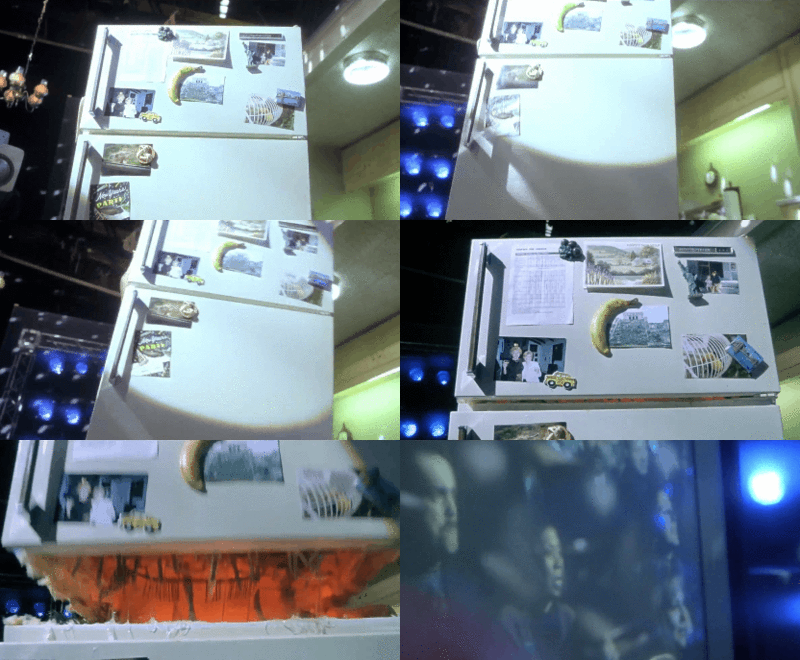
I remember thinking the fridge looked like the one that rattles around in Requiem for a Dream.
After registration it was the introductory speech. First English, then Tamil. The girls sat the opposite side to the guys. The speakers were quite bad quality and the sound echoed around the room. You had to really sit forward to hear the words.
As of this point, the Noble Silence had started. No talking for the next 10 days. For the most part I was calm, but Wow, the task ahead:
12 hours of meditation each day
Up at 4am
Finish at 9:30pm
No talking
No mobile phones
No internet
No reading, no intellectual stimulation
No exercise
No eye contact — 100% solitude
Separation from the opposite sex
2 simple meals per day (breakfast and lunch)
Halls of Residence at Dhamma Setu, Chennai
(Days: 1–3) The Training of Concentration
Meditation Hall Notes: Day 1
To develop our mental concentration, the first 3 days we exercised ānāpānā-sati — awareness of respiration.
To do this we had to identify and keep our minds focused on the sensations of breathing in and out from the area starting at the top of the nose, down each side of our upper lips — forming a triangle area.
We had to answer questions such as “was the breath:”
long or short?
heavy or light?
rough or subtle?
On day 3, we were expected to bring our attention down to an even smaller area, the philtrum — the small area underneath your nose and above your top lip.
This is to sharpen the mind so it can observe the subtlest sensations within the body.
Simple Does Not Equal Easy
All we were expected to do was keep our attention on these areas while observing the breath. Sensations that arose and passed away. Sounds simple, is simple, but this was was one of the hardest 3 days of my life.
One of the biggest surprises was just how much work was needed to direct my attention and keep it fixed on the breath.
The popular idea that meditation is time for inactivity and relaxation never felt so far away.
A Circus of Distraction
The first thing that the strikes you is just how distracted you are. I could go for 20–30 minutes being completely derailed by a thought — a plan for the future, a memory from the past. I only had to do one thing — observe sensations — but it was more than difficult to stay focused.
Distractions dragged me right through the emotional rainbow. Just like life itself, some good, some bad, some happy, some sad thoughts frothed-up to the surface.
Another surprise is that, to begin with, the insights gained by self-observation are not likely to be all be pleasant and blissful. Normally we are selective in the view of ourself. When we look into the mirror we carefully strike the most flattering pose… In the same we have a mental image of ourselves which emphasises the admirable qualities, minimises defects, and omits some sides of our character all together. We see the image we wish to see, but not the reality…
But right at the heart of Vipassana is observing reality — seeing things for the way they are. Instead of a carefully edited self-image, you’re confronted with the whole uncensored truth.
After working through the distractions — persistently bringing my attention back to my breath — occasionally I could go for 10, 20 minutes with my attention resting on my breath. The hour meditation sessions began to pass by much faster.
Sometimes I’d experience hallucinations. A mixture of peoples’ faces and places from my childhood.
The better I got at resting my attention in one place the more I began to feel an inner calm — as if a huge weight had lifted from my shoulders.
By day 4, I felt a much stronger presence of mind.
At the end of the morning meditation I would walk outside and hear the sounds of nature so clearly, without distraction, without chasing thoughts, without an inner monologue.
My mind had been brought into the present.
The Walking Strip
The Physical Agony
Another surprise is the agony you go through sitting in one place for so long. I had a small meditation mat.
I sat crossed-legged or half lotus while meditating.
At 4:30am, the first 20 minutes is relatively comfortable. As you hit the 30 minute mark, aches and pains begin to show their faces. By 40 minutes the pains turn into agony.
Unlike running across a rugby field with your adrenaline running high, you’re sedentary — sitting still — and you have nowhere to escape the pain.
If there’s one thing that got me through this, it would be the older mediators. At a guess, there were a few old boys taking the course that were at least 70. If they could work through this, then what the fuck excuse did I have?
(Day: 5) Adhiṭṭhāna
Adhiṭṭhāna has been translated as “decision,” “resolution,” “self-determination,” “will”[1] and “resolute determination.”
By day 4 we entered the Adhiṭṭhāna sessions where you’re expected to meditate for an entire hour without moving. No gentle reshuffling to a different position to take the inescapable aching pain out of your knee / leg / back. No opening your eyes. Nothing. Just still.
What surprised me about these sessions was how it forced you to bring your mind to a state of balance.
The word used to describe the state of mind is Equanimity:
“is a state of psychological stability and composure which is undisturbed by experience of or exposure to emotions, pain, or other phenomena that may cause others to lose the balance of their mind”
If you lost the balance, the physical pain would become too intense, you’d panic, you’d become overwhelmed and you’d have to move.
A Quiet & Balanced Mind Can Hear Its Body
One of the things I noticed during the 10 days was how your feelings and emotions are reflected as sensations in your body.
When I experienced a thought that made me feel sad, I felt it right in the middle of my solar plexus. When I feel stressed, I felt tension right around the back of my head. When I feel anxious, I felt it in my stomach and facial area. The list goes on.
Meditation brought my mind to a place where I could identify those subtle sensations.
(Day: 7) The Power of Observation
Meditation Hall Notes: Day 7
Possibly the most powerful experience of the whole 10 days happened on day 7. I’d managed to follow through on all Adhiṭṭhāna sessions (no moving, no eye opening for the hour) up until this point, but during the mid morning session of day 7, about 10 minutes in, I began feeling a sharp pain in my left knee.
I’d sat in a bad position that was putting a lot of stress on my knee.
Rightly or wrongly, I was determined to not let the pain get the better of me — I wanted to make the whole session without moving.
As I hit the 20 minute mark, the pain in my knee was sharp and throbbing. For a few moments I tried to think about something else to avert the pain; this goes completely against the principles of Vipassana.
This was bad. I remember being close to tears — in pain, in frustration.
Remembering the fundamental principles of Vipassana (observation and a balanced mind), I started observing the pain. Trying my best to keep my mind calm and balanced, I began answering questions like:
Is it a pulsing pain, or is it a constant pain?
Is it a sharp pain, or is it an ache?
Exactly whereabouts on the knee is the pain coming from? Is it the same pain on the top as it is on the bottom?
Are there any other sensations that are arising over the knee?
I kept cycling over those questions again and again.
As I was working through answering the questions as objectively as possible — without reacting to the pain — I couldn’t believe what happened before me.
The pain faded away.
I’d gone from complete agony, to feeling comfortable and calm. I remember my knee feeling warm and a subtle tingling sensation spreading over my legs but that was it. The agony had passed away.
This was the power of observation.
For me, this was the biggest takeaway from Vipassana. Instead of blindly reacting to sensations in the body — which makes us agitated and miserable — we can observe them with a balanced mind. As we continue to observe them objectively — without reaction — the sensations begin to unravel.
They become less intense, they affect us less.
And since the body’s sensations are the direct bridge to the mind’s emotions, observing them unravels their intensity too — until our minds are balanced and calm.
We can unravel the /craving/ sensations for sugar, for alcohol, for cigarettes, for attention and all the other primate bullshit.
We can unravel the /aversion/ to public speaking, to running that extra mile, to having that difficult conversion, to taking action.
I used to look up at this triangle formation the palm trees made. Is there a hidden message there? :)
(Day: 10) Course Completion
As the noble silence lifted and the course came to a close, I bullet-pointed how I felt:
A strong sense of calm
More awake and alert
I needed to sleep less
3] Vipassana & Beyond
My big takeaways and some loose ends I’m trying to get my head around:
Deleting your passion
Ultimately, I see Vipassana is a teaching of dispassion. Passion is the enemy of a balanced mind. If I follow Vipassana properly, I shouldn’t fall in love with a piece of music. Doing so leads to cravings, which creates attachment and attachment leads to misery.
So just as Vipassana expects us to not react to negative emotions, we’re expected to not react to positive emotions too.
I work in startup companies where the life of the company is almost completely dependent on the relentless hard work, determination and /passion/ of the founders. To my mind, the latter is the most essential ingredient.
What happens when passion is taken out of the equation? Does the same amount of hard work go in?
If founders thought about things clearly wouldn’t they see that the deck is stacked against them and that they’d be better off taking a job in the city?
“My big problem with it culturally is the way it devalues the senses and the wonder of the physical world. Isn’t our will to power also glorious? Where is the joy in dancing, in loving, in craving, in living? Can’t a meditation embrace this, not cut it out?”
Being Present
I found ānāpānā-sita — the training of concentration to be fruitful. I’ve often wondered what the zen-types meant when they point out that being present or presence of mind is bliss.
Once you develop the awareness it’s fascinating to realise how distracted in thought you actually are throughout the day — experiencing an orgasm is probably one of the few exceptions.
Meditating to bring the mind into the present was positive for me.
It’s calming, it helps you think clearly and it connects you to your surroundings. You can remember peoples’ names, you can see things clearly.
Use the past to inform your present, but don’t live in the past — and all that jazz.
I think I had a brief taste of this during the course, and it’s something I’ll continue to work on.
Gross Sensations Saṅkhāra?
I value how Vipassana concentrates on the practical, the experiential, the see for yourself teachings of Buddha.
There are however a few exceptions, even if we set aside the widely debated assumption of rebirth, a supernatural phenomenon.
Goenka — the course teacher — explains that the gross sensations (aches, pains) you experience when meditating are your saṅkhāras — mental conditionings from either this life or former lives.
According to the teachings, saṅkhāras — mental conditionings — are impurities of the mind that distort our view of reality, making us agitated and unhappy.
The goal is to use Vipassana meditation to remove our stock of current and past saṅkhāras — this brings us to liberation, a pure and balanced mind.
“Not necessarily pain, they can manifest in different ways. They can come out as heat, they can come out as pressure, throbbing, as subtle vibrations. According to the type of sankhara, that type of sensation there will be.”
For me, this is a bit of a water jump.
Unlike the emotion to sensation connection you can experience for yourself — there’s no experience or rationale explanation that connects the saṅkhāras to physical pain.
Particularly when coupled to notions of previous lives, the idea that saṅkhāras are reflected as physical pain during Vipassana mediation seem a bit abstract to me.
Pinpointing the Cause of Calm
For all of the positive outcomes that I felt after taking the Vipassana course, initially I found it difficult to pinpoint what the cause was. Thinking about it, it could have been:
The solitude — no social pressure, no burning energy communicating with others
Unplugging from the internet
Avoiding almost all forms of intellectual stimulation (reading, writing, sketching, planning)
The environment
The Vipassana meditation itself
It’s now been over 4 months since I took the course. Now I’m confident that my sense of calm, positivity and mental alertness after the Vipassana 10 day course was in-fact a direct result of the meditation.
I say this because during 6 months of travel in India I’ve been fortunate to experience days — even weeks — where I’ve been unplugged from the internet as well as a few days trekking in solitude, but I don’t report the same experiences as the days where I’ve meditated.
Return on Investment
“My favourite things in life don’t cost any money. It’s really clear that the most precious resource we all have is time.”
— Steve Jobs
Time indeed is our scarcest resource. Even with this in mind, I’m happy I invested time working on Vipassana.
For me, the 10 day course was an outline of the work you have to do going forward, not job done. Vipassana is a lot of work, and I’m not 100% sure I will — or even want to — complete the path to full liberation.
That said, I do see that certain steps along the path will be good for me to follow — particularly the training of concentration. Today we are distracted people and I worry that in a world where Silicon Valley is in a race to the bottom of your brain stem, things could get a tad worse.
The presence of mind and calmness I’ve experienced with mediation is a slam dunk for me — completely worthy of the time invested.
Waking Up
The more life experience I get, the more I believe anything that improves your awareness is good. Ignorance for the most part is a problem.
Awareness of your actions, your feelings, your intentions, your cravings, your aversions puts you in the driving seat.
It’s waking up.
Awareness gives you a clear path to make the changes you need to improve yourself. Or — for those lucky ones — the clarity you need to know that you’re already a brilliant person.
Vipassana helped to develop my awareness, it woke me up.
And for that I’m grateful.
Are You Fine?
I’d recommend taking a Vipassana Meditation Course if you are someone who is:
Interested in learning meditation — a Vipassana 10 day course will serve as a brilliant crash course.
Constantly feeling agitated, unsettled, discontent with yourself, others, your possessions — the time to reflect and find your inner calm will be good for you.
Distracted or stressed — the ānāpānā — training for concentration will help to bring your mind into the here-and-now, to the present, which is calming and awakening.
His voice is deep in tone and loud in volume. He’s articulate but at times his English is a bit broken or his grammar is out of whack—but it’s a fair bit better than my Swedish that’s for sure.
He has a filthy sense of humour so we get along just fine.
Last night we were walking back from the night market in Chiang Mai.
When we got back to our hostel, we started chatting with a few girls from California.
In a way that resembled the national lottery “it could be you!” advert, Andreas turns around, points and asks “how young are you?” to one of the girls.
We laughed.
After a moment passed, I thought; imagine if you could answer that question: “I have 32 years, 4 months and 17 days left before I die.”
We laughed about asking the question: “so mate, how many years have you got left?”.
Andreas thought it would be a good one to ask the mother in law when she’s giving you a hard time.
I thought about it again in the shower this morning.
It’s weird thought experiment, but, if we knew, I wonder if we would make any changes to:
The way we spend our time
The way we think about our legacy
The way we think about what others think of us
The grudges we hold
The way we spend our money
The way we earn our money
The amount of peanut butter we eat
You are going to die is a powerful reminder — we are already naked.
Trekked over to the other side of Hanoi to Bún chả Hương Liên — where Obama and Joe Biden came for Bún Chả (noodles, greens and bbq pork strips in a f-u-c-k-i-n-g sensational soup).
The lady pictured top left came to sit opposite me.
She spoke exceptionally good English. She pointed out hardly any westerners visit the restaurant and asked how I knew about this place (thanks Anh Túc).
I said her elocution was better than mine – to which she replied “yes, I am a news presenter for one of Vietnam’s biggest broadcasters”.
I just got back from Koh Rong – an island off of the south west coast of Cambodia - and I’m en route to Phnom Penh, the capital of Cambodia.
It’s comical how far some of the coach drivers stretch the definition of a direct journey.
About 4 hours in and we’ve been picking up and dropping off random people at random places. Clearly the driver is sticking some $$ in his arse pocket and taking us all on a detour.
An Italian guy just shouted his head off about it, saying he will report the driver to his office. The driver looks scared and apologetic.
If it wasn’t for needing to piss like a race horse, I would’ve been fine with the detour. Lots of happy Cambodians waving frantically, living in the most remote conditions.
On reflection Koh Rong was beautiful. I arrived there late afternoon on Thursday. As soon as I got off of the boat, I hung a right and walked along the beach and then into the jungle for about 3km until i had my own patch of beach – then I pitched up my hammock for the night.
The sun makes for a good alarm clock and on my first morning I caught sunrise. Favourite time of day by far.
When I jumped out of my cocoon, I noticed there was another hammock next to mine which was a bit odd — I was in quite a remote area and a fair way into the jungle.
A few hours later and The dude from the other hammock woke up –turns out his name was Tom too. Tom 2.0.
Tom 2.0 was from Munich (Germany), had dreadlocks and was a fair bit cooler than Tom 1.0.
We compared hammocks. Tom showed me how to do a simpler fly knot. I showed him how to tie and adjustable lasso knot for his canopy. There was a bit of a language barrier but the knots went right over it.
We saw a huge platform that the local people used for fishing.
Being stupid enough to sleep in a jungle with 16 different poisonous snakes (some venoms can end your life within hours) naturally we ignored the danger and no entry signs and decided to dive off of it.
The view from the top.
After we were bruised and sore from two jumps off of the platform, Tom 2.0 showed me the best place to get breakfast and the best place to buy mangos. Probably the best mangos I’ve ever had.
Tom 2.0 forgot his wallet so I said I would buy his breakfast for him. He started to walk back the whole 3km to get it, I insisted I would pay and carried him in the opposite direction . We had breakfast and spoke about travel plans and what we did for a living. We shared a mutual disappointment for the lack of decent techno music in south east Asia.
After breakfast, I left Tom to go on a jungle trek to a paradise called Long Beach. Most people take a taxi boat, but I fancied the trek.
Narrowly avoided being attacked by a bunch of dogs. I love dogs but these were angry ass fook dogs showing their teeth and their owner was no where to be seen. Lucky I had my trusty stick and remembered to be firm and confident with them (sage advice dad).
I remembered that snakes aren’t usually confrontational , so I played music on my phone sothat they’d hear me coming and move off of the track.
Left my mark on this sign. Just before the rock climbing down the cliff face started.
After about 2 hours trekking I reached a rocky cliff that you have to climb down.
At the bottom jt was paradise. A beach with white sand and crystal blue water that stretched as far as you can see. Hardly anyone was there. Felt like I had the place to myself.
I walked in the blazzing heat for about an hour and a half– only stopping for a mango and glugs of water .
Eventually I found a little beach bar. Had the most amazing banana shake and bumped into two lively girls from Melbourne.
Aussie girls like doing this at sunset.
We negotiated hard and managed to get a taxi boat back after sunrise for $2.
Nearly dropped my phone in the water for this photo.
When I got back to my hammock there was a $5 note tucked on the main fly line.
Must’ve been Tom 2.0, who had moved on to the other side of the island #travelling
Onboarding customers to your new product is tricky.
Onboarding customers to a new financial product is really tricky.
For a mountain of security and regulatory reasons you’re required to collect and validate a towering number of data points.
Of course, for each additional data point that we had to collect = additional cost to the customer = increased risk that they might drop-off and watch videos of otters eating lettuce instead.
Fruitful’s onboarding steps
In Fruitful 1.0 (more about the pivot here ) these were the steps for onboarding new users:
States and actions of the customer onboarding steps. (AML) Anti-money laundering
Our definition of a successfully onboarded customer was:
“A customer that has created an account and invested money.”
We experienced drop-offs in two key areas:
During account creation
States and actions of the customer onboarding steps. (AML) Anti-money laundering
Looking at the user flow for onboarding, you’ll see that if customers failed the automated anti-money laundering checks, they had to upload:
Proof of identification — e.g. driving license or passport
Proof of address — e.g. utility bill
Although we lost a small percentage at the verify email and verify address step, we (unsurprisingly) lost the majority at the manual verify step. We made some assumptions for why we experienced drop-offs here:
Customers might have been at work or somewhere else outside of the home where the documents lived
Customers might have not had enough time to find the documents
More and more customers are using electronic bills, so they might have had to request a statement (or similar) from their bank
After account creation
Circling back to our definition of a successful onboard, we needed a customer to invest money to reach our goal.
This leads us into the second area we experienced drop-offs: As we began scaling the number of customers with verified accounts, a growing proportion were not investing money.
Some assumptions for why:
People’s financial circumstances change all the time, maybe some people were waiting until they had enough money to invest
Maybe some people couldn’t get comfortable that we were a new finance company
Some might’ve ran into technical problems
Some folks might’ve just been nosey
Our growing list of assumptions pointed to one thing: We needed a better way to communicate and engage with our customers throughout the onboarding process.
Intercom pitch themselves as a customer communication platform. For us they offered a quick and easy way (literally, we dropped in a javascript snippet) to engage with our customers based on their behaviour.
Tracking & Segmenting
As soon as we were set up we using Intercom we started by tracking and segmenting customers. Straight away we had a birds eye view of our customers, their profile and their activity on Fruitful.
Example of the Segmenting & Tracking View
For onboarding in particular, we could see things like:
Whether or not they’d verified their email account
Whether or not they’d passed the anti-money laundering checks
Whether they’d made an investment
The last time they logged in
The device they were using
With these capabilities, we were able to segment our customers into groups and communicate with them in ways that would help them onboard successfully.
Let’s zero-in to two segments to understand their behaviour, how we engaged with them and how we made a huge impact on the number that onboarded successfully:
Segment 1 = Fallen down the crackers:
Customers that had created their account
Had not passed the automated anti-money laundering checks
Needed to verify their proof of identity and address by manually taking photos/scanning their documents and emailing them over
Segment 2 = Flying visitors:
Customers that had created and verified their account
Had signed in 3 times or more
Had not made an investment
Reducing drop-offs
How we rescued the fallen down the crackers
To engage with the ‘fallen down the crackers’ — customers who had dropped-off after failing the automated anti-money laundering check during the account creation — we implemented the following messaging strategy:
Message [1] “It’s cool, don’t worry”:
When: As soon as the customer had failed the automated check
How: In-app message
What:
We explained that this was nothing to worry about — you can fail the automated checks for a number of reasons i.e. recent move, not registered to vote, different registered address etc. etc. etc.
Anchored to the point above, we reframed the problem as our problem, not theirs
They could upload their evidence right here in the chat window if they had their documents to hand
Message [2] “A quick follow up email”:
When: Sent on the same day
How: Fruitful branded email
What:
Good work creating your account
We just need you to verify your address and identification
Here’s how you do just that
Message [3] “Reaching out to see if you’re ok”:
When: The following Saturday morning
How: Plain text email sent from one of our team, usually me
What:
Is everything ok? Anything we could do better?
We’d noticed that you hadn’t opened your account
We’re here to help
Results & what they suggested:
In the first week, we saw just over 18% of our fallen down the crackers go on to verify their account
Over the course of 4 months, we increased the percentage of those who ‘verified their account’ from 61.2% to 80.6 %
Interestingly, not many converted on the first in-app message. 58% converted on message 3 — which dovetails with our previous assumption that peeps probably didn’t have their proof of identity / address on them at the time; yet Saturdays were more convenient to dig out the said documents
Given message 3’s performance, it’s safe to assume that most of the increase in conversions could be attributed to simply /being reminded/
We were able to capture skeptics with message 1. A small percentage of prospective customers asked us why they had to verify their address in the first place. The in-app chat made for a excellent place to have a quick exchange with customers to explain why
Increasing first-time investments
Catching the flying visitors
The flying visitors were the prospective customers who had logged in 3 times or more, had a verified account, but hadn’t made an investment. We assumed the multiple logins might be a good proxy for; I’m interested, I’m just not sure about something.
For these customers, we engaged with them slightly differently:
Message [1] “Making an investment is easy”:
When: first visit to the deposit view
How: in-app message
What:
We ran an in-app message that bubbled-up on the customers first visit to the ‘make an investment’ screen. We thought this might offer some reassurance to those who were a little skeptical of a new online-only financial company.
💡Interesting aside: We ran two versions on an A/B test and found that the message where we linked to our FAQ increased first-time investments 30% more than the message that didn’t, even though next to no one clicked the link.
Message [2] “High fives on creating your account, you’re good to go”:
When: 2 days after signing-up
How: Fruitful branded email
What:
Congratulating customers on setting-up and verifying their account
Presenting their account info so that they could go ahead and make a investment right there
Message [3] “See who else is using Fruitful”:
When: at least 2 days after previous message [and] only on Saturday mornings
How: Fruitful branded email
What:
Here we offered-up some social proof alongside the goal gradient effect that shows what you’ve completed and what’s next.
As humans get closer to /reaching a goal/, their efforts towards that goal significantly increases — user interface patterns like this have an enormous impact on conversions, but that’s a topic for an upcoming post.
Message [4] “Follow-up, is everything ok?”:
When: at least 2 days after previous message
How: Plain text email sent from one of our team
What:
Results & what they suggested:
The initial group ‘flying visitors customers’ were tagged ‘Before Intercom’ so we could see the before and after. In just two weeks we converted a towering 23.8% of them to successful onboards (i.e. made an investment)
In net marketplace investments, that equated to over £160,000
Out of the successful conversions, messages 1 and 2 accounted for 78.8% of the conversions
Importantly, message 4 prompted some customers to ask us extra questions that helped them get comfortable with what we were offering. A few of those went on to be some of our largest investors
Ultimately as a new finance company we were selling reassurance. Using Intercom to engage with customers at appropriate moments with relevant messages helped us do just that
Some takeaways
After spending a bunch of time knee-deep in Intercom, we began to figure out what worked well and what didn’t. In no particular order here are some takeaways I’d offer:
The power of plain text
We found that more often than not, emails that were sent in a plain text format from an individual (someone from our team) performed better (increase in step goal) than those emails from Fruitful, in a branded email template.
Your milage may vary.
Work that scheduler
Assuming you’re using Intercom, get creative with the message scheduler and think of sending messages at times that fit your customers’ context. Context could mean, where they are, what time of day, the device they’re using and so on.
We found that messaging customers on Saturday mornings to send us their proof of identity and address was most effective. Why? A safe assumption might be: Most people would be at home on a Saturday morning and therefore they’d be able to dig out their documents, dust them off and email them in.
Be the best with an A/B test
Whatever customer engagement product you go for, make sure you can run A/B tests on the messages that you automate.
We found this to be super powerful. As we mentioned above, simply offering a link to our FAQs increased the number of customers that made an investment by 30%.
No A/B tests, no way to iterate, measure and improve.
Approach requests for feedback like dating
Haven’t been dating in over half a decade so I could be way out west on this analogy — but! Intercom is a superb fit for collecting customer feedback.
Like dating, you don’t want ask for everything on your first meet. Be succinct when you ask for feedback. We removed friction even further on our initial feedback requests by offering up simple thumbs up/down vote—like a cheeky wink from the other side of the room to gauge the response.
If we received a response (akin to a swipe on Tinder?), we’d follow up with something like:
“Hey Olivia, just wanted to follow up to get your thoughts on the updates to the invest screen. Can you tell me what’s not working for you?”.
Asking customers to write a testimonial for you is a big ask—like do you want to move in with me big—but asking customers if they’re happy with you publishing their positive feedback they’ve just messaged you certainly lowers the bar.
Forgotten what happens in dating after this, so probs best to leave this here.
You can have 1 but you cannot have 2
With all your messaging, you want to present just one call to action or question, i.e:
Hey Phin, we’ve just rolled-out an update too the withdrawal screen — is it clear how you’d make a withdrawal?
You’ll only be disappointed with your results if you ask for more than one thing. Either one thing will get missed, or customers will ignore your messsage all together.
Get respectful or die tryin’
To finish on finger-pointing housekeeping note: Be mindful of your customers when you’re implementing your messaging plan. Specifically, make sure you’re not bombarding your customers with emails and in-app messages everytime they login—attention is a finite resource and your customer engagement strategy should be mindful of this.
Intercom has a simple yet powerful tool to help you regulate the time between contacting customers—you can target based on last contacted.
Overlook the importance of this and you’ll run the risk of customers hitting that juicy unsubscribe button which, to be clear, brings all of your wonderful customer engagement plans to a screeching halt.
Stay tuned
Be sure to follow Fruitful’s Ingredients blog so you can join us in an upcoming post where we’ll look at how we made changes to our user interface designs that resulted in double digit % improvements to our successful onboarding rates.
Always read the Ingredients. Have the occasional note, insight or idea on topics such as design, software development, hiring, finance and keeping your sanity when building a company delivered fresh, right to your inbox ➙